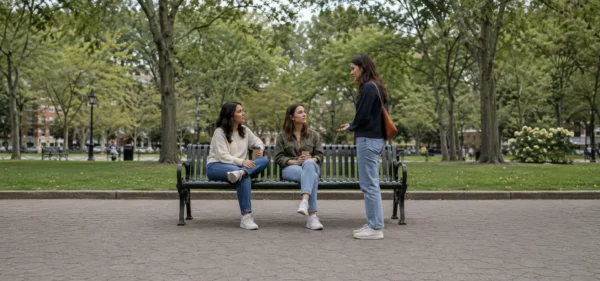


Feeling left out by friends is one of those experiences that can knock the wind out of you, even when nothing dramatic actually happened. Maybe you saw a group photo from a dinner you weren’t invited to, or found out about weekend plans after the fact, almost by accident. It doesn’t take a big betrayal to sting, and if you’ve been quietly replaying the moment and wondering whether you’re overreacting, you’re not. Feeling left out by friends is a common, normal experience, and there’s a practical way through it that doesn’t require confrontation or guesswork: talking about it, clearly and kindly.
At Gofrendly, a women-only friendship app built around real connection, we hear versions of this often. Feeling excluded by a friend group is rarely one dramatic event, it’s usually a build-up of small moments that leave you unsure where you stand. This guide walks through why feeling left out by friends hits so hard, and exactly how to bring it up without making things worse.
Key takeaways
- Feeling left out by friends is a common, valid experience, not something to brush off or feel embarrassed about.
- The most effective way to address it is a calm, private conversation that uses “I” statements instead of accusations.
- Timing, specificity, and a genuine desire to reconnect matter more than finding the perfect wording.
Why feeling left out by friends hits so hard
Humans are wired to notice exclusion, even in small doses. Researchers who study social rejection have found that the brain processes exclusion in some of the same regions associated with physical pain, which is part of why feeling left out by friends can feel so disproportionately painful compared to what actually happened.
That reaction isn’t a character flaw. It’s a signal that belonging matters to you, and that the friendship is worth paying attention to. The problem isn’t the feeling itself, it’s what happens when you sit with it in silence, turning the same scene over and over without ever finding out what your friends actually meant by it.
One ostracism moment a day
In a two-week diary study of everyday social exclusion, participants reported experiencing an average of one moment of being ostracized or left out every single day, and those moments still measurably lowered self-esteem and mood even when the exclusion was minor or unintentional.
Source: Kipling D. Williams, “The Pain of Exclusion,” Scientific American Mind (2011)
Reflect before you react
Before you say anything, give yourself a few honest minutes to work out what actually happened. Was this a one-off, or does feeling left out by friends keep happening with this same group? Was there a plan you were realistically included in that quietly changed, or is this more about a pattern of not being looped in?
This isn’t about building a case, it’s about making sure that when you do talk, you’re describing something specific and real instead of a vague, defensive feeling. “You forgot to tell me about brunch on Saturday” is something a friend can respond to. “You always leave me out” invites a very different, much more defensive conversation.
Choose the right moment

Timing changes almost everything about how this conversation lands. A calm, one-on-one moment, a coffee, a walk, a phone call when neither of you is rushing anywhere, gives your friend room to actually hear you instead of reacting defensively in front of the group. Group settings and heated moments tend to shut a hard conversation down before it starts. If you’d rather widen your circle of people to have these deeper conversations with in the first place, that’s worth exploring too.
If you can, name what you want out of the conversation before you start it. You’re not trying to win an argument or catch anyone out, you’re trying to understand what happened and find your way back to feeling included.
Use “I” statements instead of accusations
This is the single most useful shift you can make. Instead of “you left me out,” try “I felt a little left out when I found out about the trip afterward.” The difference sounds small, but it changes everything about how the other person receives it, one is an attack, the other is information about how you felt.
Stick to specifics instead of generalizing. Describing one concrete moment when you were feeling left out by friends is far easier for someone to respond to honestly than a blanket accusation covering months of hurt feelings. Specifics also make it much less likely that your friend will get defensive and shut the conversation down.
“Feeling left out by friends is rarely about one dramatic moment — it’s usually what happens in the silence afterward, when nobody says anything at all.”
— Gofrendly Editorial Team
Let your friend respond, and actually listen
Once you’ve shared how you felt, give your friend real room to respond. In a lot of cases, feeling left out by friends comes down to genuine oversight rather than intention, a group chat you weren’t added to by mistake, plans that came together last-minute, an assumption that you were busy. That doesn’t erase how it felt, but it does change what needs to happen next.
Listen for what they say without immediately preparing your rebuttal. If their explanation feels incomplete, it’s fair to say so gently, “that makes sense, and I still think it would help if we found a way to loop each other in earlier next time.”
Focus on strengthening the friendship, not winning the conversation
However the conversation goes, try to end it by naming what you actually want: to feel included and close to this person again, not to prove a point. Most friendships survive an honest conversation about feeling left out, what they don’t always survive is silence, followed by slowly pulling away without ever explaining why.
If the friendship is generally solid, a conversation like this can actually deepen it. You’ve shown that you trust the relationship enough to bring up something uncomfortable instead of quietly disappearing from the group.
When feeling left out by friends points to something bigger
Sometimes one honest conversation clears everything up. Other times, feeling left out by friends is a sign that your current circle has quietly drifted, and the group dynamics you once fit into don’t quite work for you anymore. That’s not a failure on your part, friend groups shift, and so do the people in them.
If that’s what you’re noticing, it can help to widen your circle rather than only trying to repair the one you have. That doesn’t mean giving up on existing friendships, it just means you’re not putting all your social weight on one group that may not have room for you right now. On Gofrendly, a women-only app, that looks like connecting with women who are actively looking for the same kind of real, dependable friendship you are.

Download Gofrendly
Because friendship’s always worth the storage space.
FAQ – Feeling Left Out by Friends
Is it normal to feel this hurt over something small?
Yes. Feeling left out by friends often feels disproportionate to what actually happened, and that’s a known pattern, not a sign you’re being dramatic. Small moments of exclusion can trigger a genuinely strong emotional response.
What if my friend gets defensive when I bring it up?
Stay with your own experience rather than escalating. Repeating a calm “I” statement, “I’m not trying to blame you, I just wanted you to know how it felt,” usually de-escalates faster than defending your right to feel the way you do.
Should I bring it up in the group, or one-on-one?
One-on-one, whenever possible. Feeling left out by friends is already a vulnerable thing to admit, and a private conversation gives both of you room to be honest without an audience.